























MeitY, the Governments of Maharashtra and Odisha, TRAI, and IFSCA receive top honours at CIPCA 2026
New Delhi [India], March 19: Civis, the Mumbai-based civic-tech non-profit working to strengthen public participation in policymaking, hosted the third edition of the Civis Public Consultation Awards (CIPCA) 2026 in New Delhi, bringing together senior policymakers, regulators, researchers, and practitioners to recognise institutions advancing more transparent, inclusive, and responsive governance.
This year, the awards assessed 390 public consultations conducted in FY 2024–25. From these, 45 consultations were shortlisted and 18 nominated across the categories of Best Consultation for Ministry, State Government, and Statutory Body, alongside a Special Mention for Volume of Consultations. Taken together, the awards offered a snapshot of how public consultation is evolving across India’s policymaking landscape — and of the growing need for stronger institutional culture and capacity to sustain it.
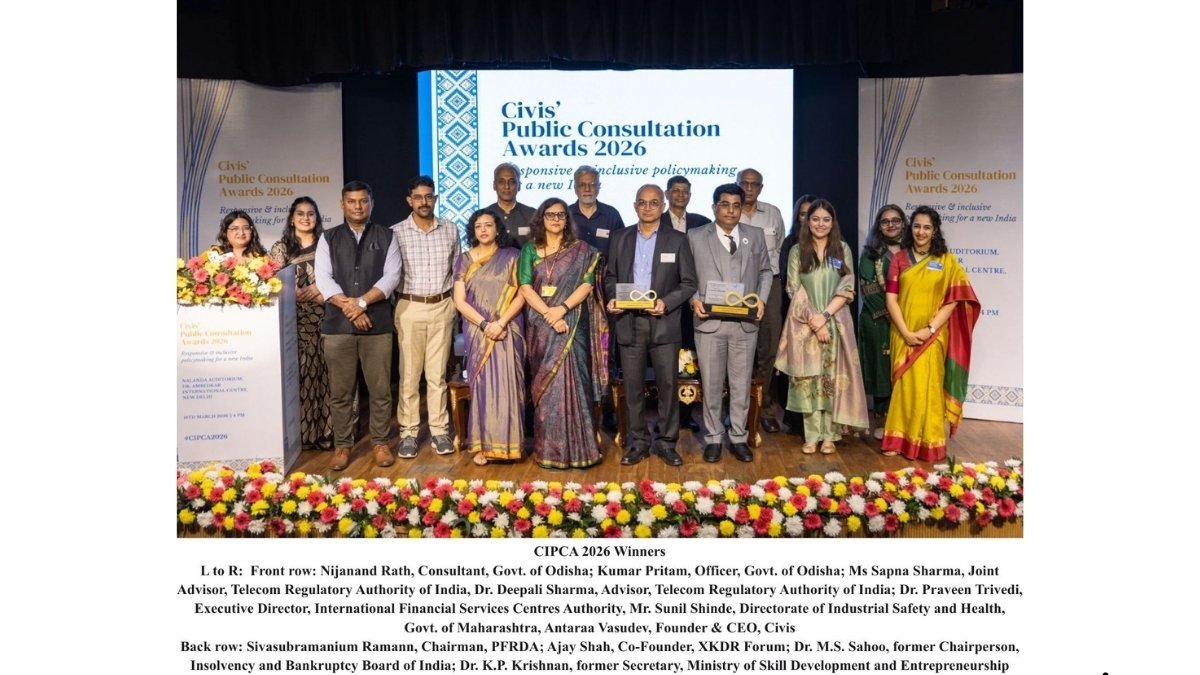
The Best Consultation – Ministry award was presented to the Ministry of Electronics and Information Technology (MeitY) for its consultation on the Report on AI Governance Guidelines Development from Public Consultation. The Best Consultation – State Government category saw a tie, with awards going to the Government of Maharashtra for the Draft Maharashtra Factories (Amendment) Rules, 2025, and the Government of Odisha for the Odisha State Data Policy. The Best Consultation – Statutory Body award went to the Telecom Regulatory Authority of India (TRAI) for its consultation on the Regulatory Framework for Ground-based Broadcasters. The Special Mention – Volume of Consultations was awarded to the International Financial Services Centres Authority (IFSCA) for integrating consultations across 66% of its regulatory activity.
A special video address by Dr. V. Anantha Nageswaran, Chief Economic Advisor to the Government of India, drew a clear connection between public consultation and economic growth. “Public consultation is not just a democratic ideal; it is also an investment in efficiency,” he said, noting that policies grounded in citizens’ lived experiences are more likely to reduce friction, build trust, and accelerate impact. He added, “Data-driven participatory governance can build state capacity, which is essential for the Indian economy to scale. In a rapidly urbanising nation, the state must increasingly act as an enabler — inviting ideas, nudging behaviour, and building policy through a more responsive relationship with citizens.”
Congratulating the awardees, he described the winners and nominees as “pioneers of this shift,” noting that repeat recognition of some institutions across CIPCA’s editions reflects how some institutions are beginning to embed participatory governance more deeply into practice. MeitY was previously a nominee in 2025; the Government of Maharashtra had earlier been nominated in two categories in 2025; and TRAI had won one titles in 2024. FSSAI, PFRDA and SEBI too have featured repeatedly across editions, reflecting that consultation-led governance is growing deep roots.
Delivering the keynote address, Shri Sivasubramanian Ramann, Chairperson, PFRDA, stressed that consultation must be understood “In today’s world, good governance is defined not only by how well policies are drafted, but by how meaningfully they are shaped through public participation. When governments learn to listen well, consultation becomes a powerful mechanism for grounding policy in reality.” He noted how PFRDA has worked to institutionalise a more evidence-based, transparent, and accountable approach to the making and review of regulations. His remarks also reflected on the authority’s wider journey, with PFRDA having been recognised by CIPCA in earlier editions as a 2025 winner and a 2024 nominee in Responsive Governance.
The event also featured a fireside conversation between Shri S. Krishnan, Secretary, Ministry of Electronics and Information Technology, and economist Dr. Ajay Shah, a member of the CIPCA jury since 2025. Their discussion focused on how public consultation is being shaped within government systems, especially in the context of digital governance and digital public infrastructure. Shri Krishnan noted the impact of technology on the practice, “Technology has made it much easier to manage consultation at scale, including through platforms that can handle large volumes of public feedback. The key is to build capacity within ministries and support public-minded bodies that are genuinely committed to understanding where public interest lies.”
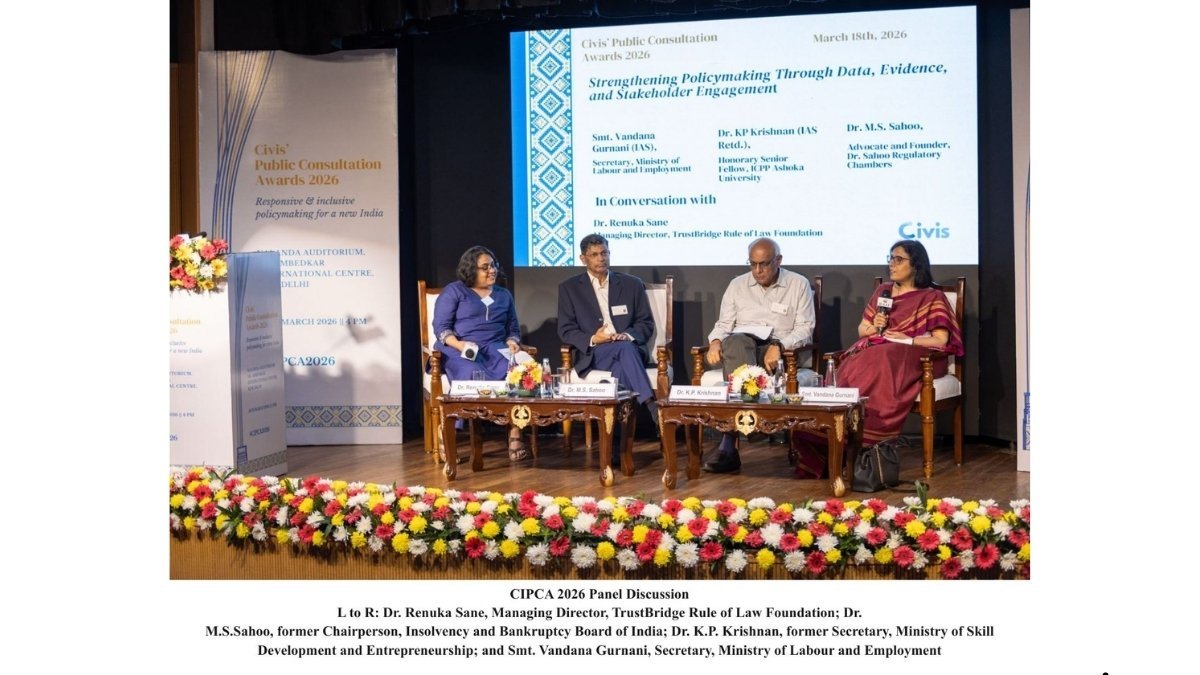
The panel discussion later in the evening brought together Smt. Vandana Gurnani, Secretary, Ministry of Labour and Employment; Dr. K.P. Krishnan, former Secretary, Ministry of Skill Development and Entrepreneurship; and Dr. M.S. Sahoo, former Chairperson, Insolvency and Bankruptcy Board of India, and was moderated by Dr. Renuka Sane, Managing Director, TrustBridge Rule of Law Foundation and Amicus to the 2026 awards. The conversation highlighted that effective consultation depends not only on opening a channel for participation, but on building credible institutional mechanisms to receive, process, and respond to feedback.
Reflecting on the forces driving consultation, Smt. Vandana Gurnani added “Consultation is ultimately about listening across stakeholders with adversarial positions, managing conflict, and consensus development” she said, noting how the labor codes underwent an extensive process with 139 consultations over many years. “In the labor sector, everything is tripartite. It is consultation of the government, as well as the employers and the employees.”
Dr. M.S. Sahoo added, “A good consultation asks for views; a great one shows that those views mattered. The Civis Public Consultation Awards recognise institutions that treat public engagement as integral to policymaking, helping build a stronger culture of transparent and participatory governance.”
Speaking on the occasion, Antaraa Vasudev, Founder and CEO of Civis, located the awards within a broader effort to strengthen participatory governance in India. “CIPCA is not only about celebrating good practice, but about helping build the culture, capacity, and norms that make public consultation more inclusive, accessible, and credible. Over time, that is what will help consultation become a more embedded and expected part of policymaking.”
Through its work, Civis has now facilitated feedback on over 1,000 draft laws and policies, gathering more than 8 lakh citizen inputs from 700+ cities and towns across India. Now in its third edition, CIPCA serves not only as a platform to celebrate exemplary consultations, but also as a lens on how public institutions are evolving. In a policymaking landscape where practices remain uneven, the awards spotlight institutions taking consultation seriously while underlining a wider opportunity of not just increasing the number of consultations, but building the systems, culture, and vision to make participatory policymaking more consistent, credible, and consequential over time.