

























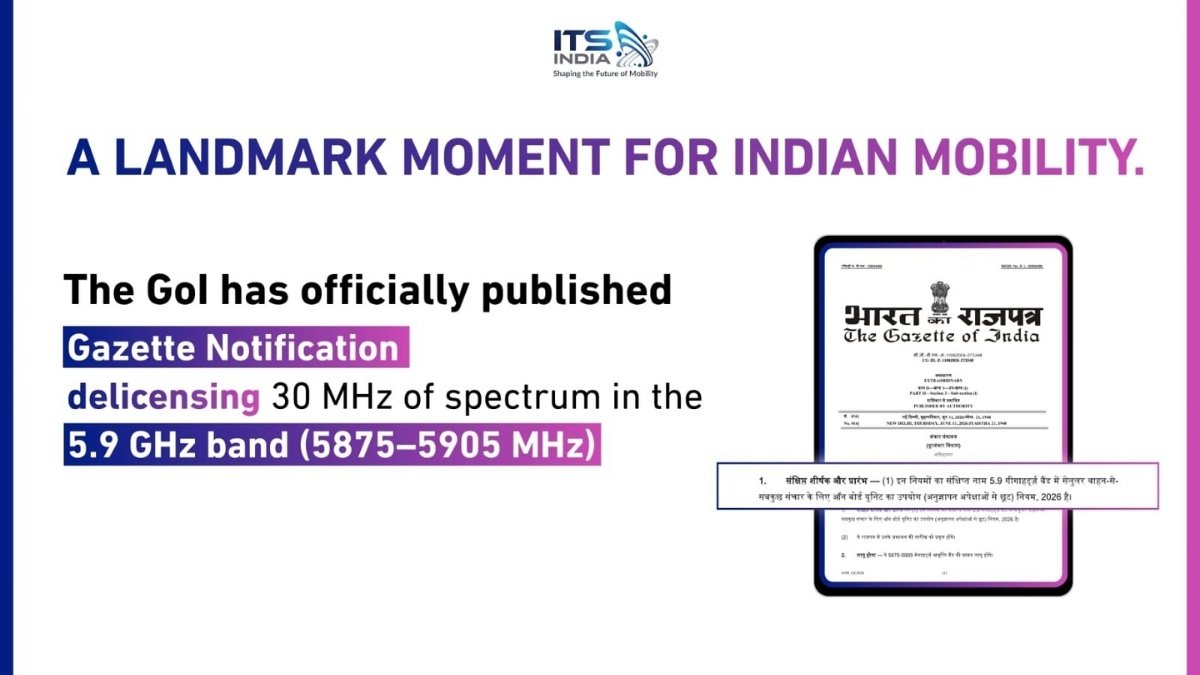
New Delhi [India], June 25: India has de-licensed 30 MHz of spectrum in the 5875–5905 MHz band for Vehicle-to-Vehicle (V2V) communication, a regulatory milestone that positions the country alongside the EU, US, Japan, and South Korea in advancing connected mobility infrastructure.
NEW DELHI — on a morning that will be remembered in the annals of Indian transport policy, the Government of India published a Gazette Notification that does something deceptively simple: it opens a frequency. But the consequences of that act are anything but simple. For the first time, vehicles on Indian roads will be able to communicate with each other, with roadside infrastructure, with traffic systems in real time, without a license, and without delay. The 5.9 GHz band (5875–5905 MHz), long the domain of technical working groups and consultation papers, is now the operating frequency of India’s road safety future.
India’s road fatality numbers have resisted every conventional intervention. Nearly 1.7 lakh lives are lost annually, a toll that amounts to one death approximately every three minutes, every day, across the length and breadth of the country. Successive governments have legislated, invested, and campaigned. Yet the roads have remained stubbornly lethal. V2X technology, cooperative Intelligent Transportation Systems that enable On Board Units (OBUs) to exchange safety-critical data with Roadside Units (RSUs) and other vehicles represents a categorically different intervention. Studies across mature V2X deployments globally indicate that the technology can prevent up to 80 percent of crashes involving unimpaired drivers. The Gazette Notification de-licensing this spectrum is, at its core, a decision to introduce that capability to Indian roads at scale.
The mechanics of the notification are precise. By de-licensing 30 MHz for V2V communication within the 5.9 GHz band, the Department of Telecommunications (DoT), in coordination with the Ministry of Road Transport and Highways (MoRTH), removes the single largest deployment barrier that has held back cooperative ITS in India: the requirement for individual spectrum licenses. Device manufacturers, automotive OEMs, ITS solution providers, and highway operators can now build, certify, and deploy V2X-enabled equipment with full regulatory certainty. The road to scale across the National Highway network managed by NHAI and beyond is now clear.
The geopolitical and industrial significance of this alignment cannot be overstated. The European Union mandated 5.9 GHz harmonization for ITS years ago. The United States, Japan, and South Korea followed with their own frameworks. India’s notification signals to global automakers, technology companies, and multilateral bodies that it is not a follower in this space it is an active participant shaping the connected mobility ecosystem of the world’s most populous nation. For V2X device standards bodies such as BIS and TEC, and for regulators at DoT, this is both a mandate and a moment.
Twelve months of deliberate groundwork made this moment possible. Structured advocacy, technical submissions, stakeholder roundtables, and inter-ministerial consultations built the groundwork, with ITS India Forum, India’s national Intelligent Transportation Systems think tank playing a consistent role in engaging DoT, MoRTH, TRAI, and the broader road transport establishment. Drawing on global benchmarks, domestic safety data, and operational evidence from C-V2X pilot deployments, the case was singular and evidence-based: de-licensing this spectrum would save Indian lives.
About ITS India Forum
ITS India Forum is India’s national think tank for Intelligent Transportation Systems and smart mobility, headquartered in New Delhi. The Forum engages with policymakers, industry, academia, and civil society to accelerate the adoption of technology-driven solutions for safer, smarter, and more sustainable transport across India.
For further information and details
Contact
If you object to the content of this press release, please notify us at pr.error.rectification@gmail.com. We will respond and rectify the situation within 24 hours.