
























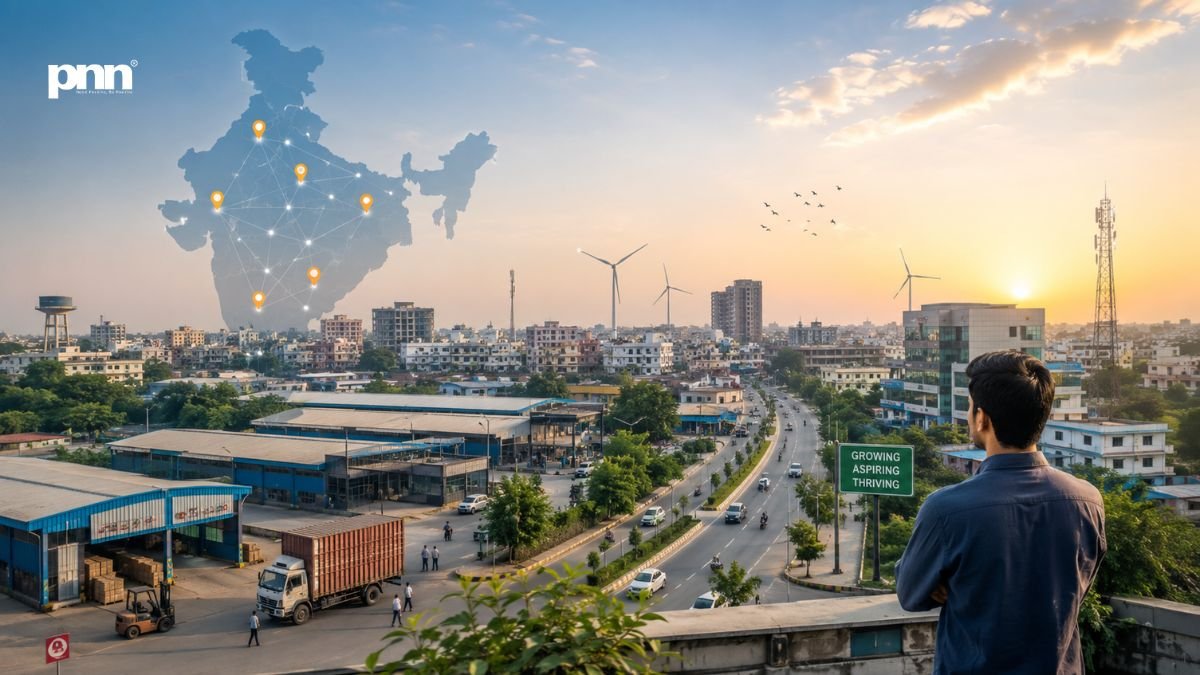
Mumbai (Maharashtra) [India], July 27: For years, India’s economic story was really just a tale of five cities. Mumbai moved the money, Bengaluru built the software, Delhi-NCR handled the politics, Chennai rolled out the cars, and Hyderabad ran the labs. Everywhere else? Barely a mention. That’s not the case anymore.
Check out a co-working space in Indore or a tech hub outside Coimbatore, and you’ll see engineers working on the same complex systems that underpin banks in London or big retailers in New York. The nature of the work hasn’t shifted much — it’s just the location that’s changed.
The Metro Squeeze
Let’s be honest, part of this shift is just simple math. Office rents in the top districts of Bengaluru and Mumbai are sky-high. Early-stage founders actually flinch when they see the numbers, and companies are stuck with fewer choices and much heftier bills as vacancy rates hit their lowest levels in five years. And those commutes? It’s not unusual for workers to lose two or three hours a day crawling through traffic. Not surprisingly, people burn out. Salaries climb as companies fight over the same shrinking pool of talent, and HR folks now talk openly about employee fatigue — it’s not a taboo subject anymore.
Against all that, a place like Jaipur doesn’t feel like a consolation prize. It’s an active, deliberate move.
Jaipur, Coimbatore, and the New Startup Map
Just look at Jaipur. Over 5,000 new companies set up shop there in a single year, and about 500 of those are already active startups. It helps that lots of them are packed into Mahindra World City, a sprawling business park that offers the kind of setup you used to only find in big metros. And with the state’s iStart program — offering up to ₹25 lakh in matching funds and things like rent reimbursements — it’s no surprise founders are setting up here instead.
Coimbatore’s a different industry, same pattern. Startups in the city skyrocketed from around 270 in 2020 to well over 1,300 in just four years. That makes up a big chunk of Tamil Nadu’s entire ecosystem. TIDEL Park alone houses more than 250 startups and employs over 40,000 tech professionals. The local business incubator is lively, and global capability centers — basically the in-house R&D arms of multinational giants — are popping up here at rates that rival the bigger cities, all at about one-third of the cost.
Bhubaneswar is another example. The city leans on its steady stream of STEM grads (over 30,000 a year) and its Infovalley SEZ, which now attracts the kinds of IT and financial firms that wouldn’t have looked past Hyderabad ten years ago. And then there’s Ahmedabad, playing its own game. With GIFT City, a strong base in textiles and petrochemicals, and top-tier institutes like IIM Ahmedabad nearby, the city is snagging both fintech and biotech investments at the same time.
The Global Capability Centre Effect
Nothing demonstrates this shift more than the explosion of global capability centers (GCCs). Right now, India has nearly 1,800 GCCs, contributing around $65 billion to the economy, and the numbers aren’t slowing down. These aren’t just call centers; heavyweight names like Goldman Sachs, Google, and Microsoft now run entire product lines and key operations out of India.
The real twist is that many new GCCs aren’t setting up in metros anymore. More and more, they’re landing in tier-2 cities, drawn by talent that costs a quarter to a third less, lower attrition rates, and a stream of fresh graduates from local engineering colleges. Even in smaller manufacturing clusters around Ahmedabad and Mysuru, companies are seeing that same story play out in heavy industry.
Flexible Offices Follow the Talent
The real estate numbers make this impossible to ignore. Tier-2 cities now have over 575 flexible workspace centers across nearly 9 million square feet—close to 29% of all flexible workspaces in India. Ahmedabad claims more than a fifth of that, and Kochi, Indore, Jaipur, and Coimbatore aren’t far behind. Lucknow, Agra, and Bhubaneswar are also joining in. These shared office spaces? They can cost half of what you’d pay in a big metro. For startups looking to make every rupee count, or for GCCs testing a city before committing, that’s a huge deal.
What This Actually Means
None of this means the metros are fading into the background. Bengaluru’s still the deep tech powerhouse, and Mumbai’s still India’s financial heart. But the idea that all ambitious work only happens in five ZIP codes? That just doesn’t add up anymore. Of the 200,000 or so startups recognized by the government, nearly half are now headquartered in tier-2 and tier-3 cities—a stat that would’ve sounded far-fetched not so long ago.
This isn’t about charity or “moving away from metros” for the sake of it. It’s smart cost control, paired with real talent, and state governments that finally learned to offer incentives that actually work. A founder in Coimbatore gets the same cloud tech and global client list as one in Bengaluru—but pays a third of the rent. Those numbers speak for themselves. It’s taken a while for everyone else to catch on, but these cities have been quietly rewriting the rules for years. Now, the spotlight’s finally catching up.