






















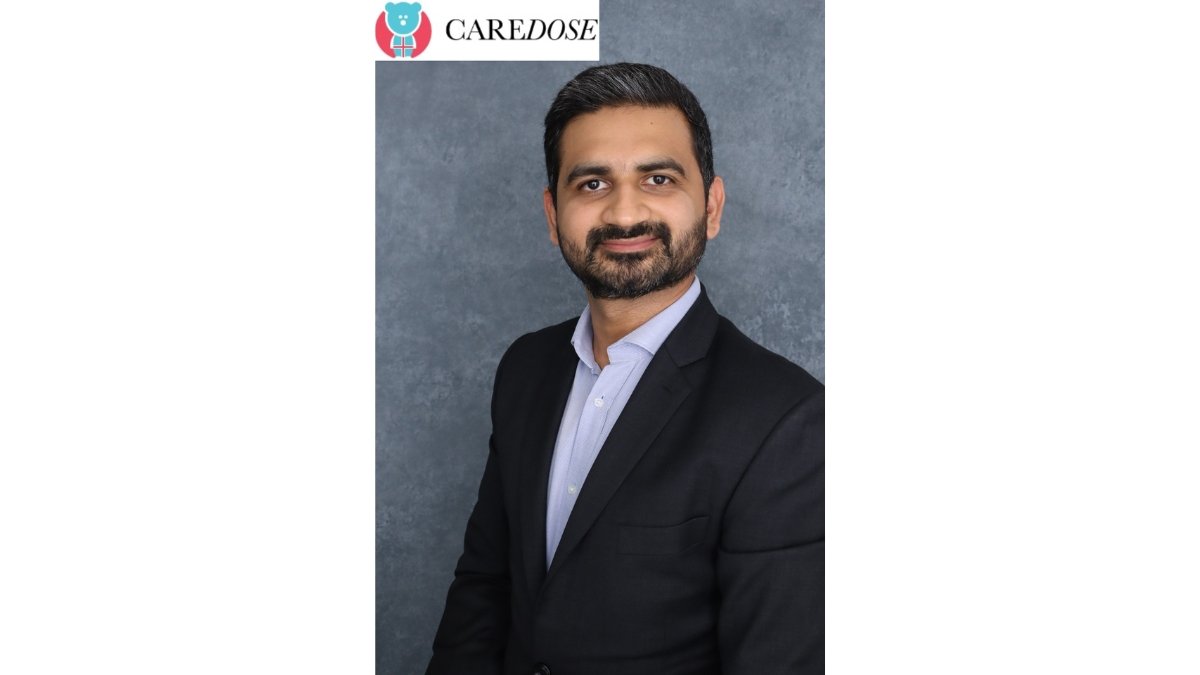
Kinshuk Kocher – Co-Founder, CareDose
New Delhi [India], June 30: Healthcare innovation often focuses on breakthrough drugs, AI-powered diagnostics, and cutting-edge medical technologies. Yet one of the industry’s most persistent challenges remains surprisingly simple: ensuring patients take the medicines they are prescribed. It is this gap that CareDose, a Delhi-born health-tech startup, set out to address by transforming medication adherence through technology, smart packaging, and patient-centric care.
During its journey, CareDose managed over a million medicine doses, partnered with organizations including the World Health Organization (WHO), USAID, the Bill & Melinda Gates Foundation, Apollo Pharmacy, and Max Hospitals, and helped healthcare providers improve medication adherence rates from below 50% to over 80%.
At the heart of this journey is Kinshuk Kocher, Co-founder of CareDose, whose entrepreneurial experience has since evolved into a global healthcare investment career at Cedars-Sinai Health Ventures in the United States. In this conversation, Kinshuk reflects on building one of India’s early medication-adherence startups, the lessons learned while navigating the complexities of healthcare, the realities behind scaling and exiting a health-tech company, and how those experiences continue to shape his perspective as an investor backing the next generation of healthcare innovators.
Q1. Caredose set out to solve medication non-adherence — a problem that has existed for decades. What made you believe in 2017 that this was the right moment to attempt it, and why did you think you were the right person to try?
Often, a lot of our problems are right in front of us. They simply need someone to experience it and have the conviction to do something about solving it. A lot of macro and micro factors came together in 2017 for us to attempt solving medicine non-adherence in chronic patients in India. PillPack, a company incorporated in the US in 2013, was trying to solve for medicine non-adherence by providing patients with pre-packaged medicine dose pouches. However, their hardware could only package open pills and hence, it could not be moved to India.
At the same time, I had just completed an MBA from Oxford and had re-connected with Gauri, a former colleague of mine from McKinsey who I had worked with on healthcare projects. We got together and decided to do something about an insight that had come from a Merck report where they had quantified the problem of medicine non-adherence at $650B for the global pharmaceutical industry. Closer to home, we ran primary research amongst our family members and neighbours and realized that at least 1 person in every household was managing at least 1 chronic ailment. The market was clearly there. And, with the growing consuming class that was willing to pay for ease and convenience, we figured that it could be a good time for us to start building something similar to PillPack but for blister pill markets such as India.
Early on, we realized that we needed complementary skill sets to succeed as a team. While Gauri brought the healthcare industry experience, I was the finance & go-to market expert on the team. We needed a strong technical co-founder as our solution required that and that is when we got Shrivatsa on board, someone who was assigned to us as a Mentor via the NASDAQ entrepreneurial program.
Q2. Managing over a million medicine doses sounds like a milestone. But what did hitting that number actually require on the ground — operationally, logistically, and in terms of patient behaviour?
A lot of iterations, refinements, prioritizations. You would imagine it to be chaotic and yes, while there was chaos in the startup world, we tried our best to always have a method to our madness. We were very process driven from the start and that enabled us to stay ahead of any potential issues. We invented a backend robot that allowed us to automate the process of packaging the medicines into pre-packaged dose pouches since the existing machines were not being able to package heterogenous material. We implemented the right CRM from the start to ensure that the patients could be managed without any delays. Patient behavior had to be changed smoothly over time. Given medicine non-adherence is a behavioral issue, it required a lot of awareness building and sensitizing from our end. We were appropriately supported by our business partners who deployed their own resources to spread the right word.
Q3. You have spoken about the gap between how founders think healthcare works and how it actually functions. At what point during Caredose did you first confront that gap personally, and how painful was it?
When we launched the services the first time, we were convinced that chronic patients would love the service and would see the value in it. The service was convenient – medication management had been simplified and we were delivering medicines before patients ran out of them, right at their doorstep. However, we soon realized that our numbers were not growing as aggressively as what we had envisioned them to. We sat there wondering why that was the case.
And, then we started making calls to seek customer feedback. What we found out was fascinating – a lot of the aged folks did not want their medicines delivered to their doorstep. These were folks whose children had already moved out of the houses and for them, getting out in the evenings and taking a walk till the pharmacy was one of their few outlets for social interaction.
They liked speaking with the pharmacist and the several known faces who they had become accustomed to seeing every other day. They did not want us to take this avenue away from them. It was baffling at the start but it made us tweak our ways and we started offering Caredose for pickup at the pharmacy too. We also realized that folks did not care for the convenience as much as we did. Most people had some caregiver at home who was managing the medication for them. And, we soon realized that our mission was not to convince the patient, but to convince the caregiver.
Q4. Caredose partnered with WHO, USAID, the Gates Foundation, Apollo Pharmacy, and Max Hospitals. These are not organisations that partner easily. How did a young startup from Delhi earn that kind of institutional trust — and what did it demand of you?
Founders keep at it until they can find a way – we were the same. We showcased our solution wherever we got an opportunity to do so. Whether it was at pitch competitions, or conferences, or networking events – we were there. We always believed in building relationships and creating a win-win for all parties. We supported our claims with real customer feedback and data. Once the first partner signed with us, it became easier to convince the others as we kept building stronger use cases with tangible data. Breaking into the public sector with the likes of WHO, USAID, and the Gates Foundation was a little different – we took our chances. We ended up in rooms where we were not supposed to be. But everywhere, we found people who were willing to support us. And, that is what made the difference.
Q5. You grew medication adherence rates from under 50% to above 80% for your provider partners. What was the single biggest behavioural or design insight that moved that number, and did it surprise you?
We created the simplest way of managing regular medication by providing chronic patients with pre-packaged medicine dose pouches. These pouches for the whole month used to go into a dispenser, which was delivered to the patient’s doorstep. There were several changes that moved adherence rates up but the single biggest factor was listening to our patients. We made several changes that came directly from there – moving from an aluminium dispenser to a cardboard dispenser, dose pouch labelling in the local language, packaging for any duration that they wanted medicines for, and delivering the next refill 2 days before they were running out of their current supplies. Some of the insights were our basic assumptions, too, but listening to the patients confirmed our thesis and made us go deeper with conviction.
Q6. There is a version of Caredose that could have scaled faster by cutting corners on clinical rigour. Did you ever face that pressure, and how did you navigate it?
More than facing pressure, it was temptation. And, yes, we did face that several times. Fortunately, we had investors who were patient with their capital and understood what we were trying to do. Hence, we did not have to succumb to that temptation or feel that pressure. Our north star was clear from day 0. We were trying to create the simplest way to manage regular, chronic medication. We believed that if we wholeheartedly tried solving the problem at hand, people around us would see that and support us.
Q7. Caredose was operating in the IoT era — smart packaging, connected dispensers, and physical reminders. Looking back now from an AI investment perspective, what would you build differently today?
In today’s AI era, Caredose could have looked very different. Workflows would have been reimagined altogether to bring in more efficiencies. AI agents, with a deeper understanding of emotions and patient experience, could have handled a lot of our patient relations & refill management. We would have been able to study drug interactions better, and their impact on the patients would have been more data-driven as we would have been able to overlay that on the baseline patient health data and study those effects on a longitudinal basis. We could have used AI to support our partners with their inventory management and logistics, which would have reduced wastage across the supply chain.
Q8. The company achieved a successful exit. What is the honest version of what that process looked like — the parts that do not make it into the press release?
We actually didn’t want to sell the company when we did. We did it because that was the best thing for the company, for it to scale to greater heights with the right resources. Then there were macro factors that convinced us to make the sale. Had it not been for COVID, maybe things could have been different. And, often, such realities do not make it to the press release. The actual process of that exit was stressful and long. A lot of tough negotiations and building an understanding of what we could compromise on and what we couldn’t budge on. At the time, we were in advanced negotiations with 2 interested parties.
The first party was one of India’s largest online pharmacies, and the second party was a strategic group aligned with a large health system. Such negotiations are always about understanding the trade-offs and then making decisions. In our case, while the first party gave us a more attractive cash offer, their vision for the idea was unclear, and the idea would not have found the right home.
The second party gave us a little less cash, but they offered us equity on top as they wanted to take the benefit of all our learnings. We went ahead with the latter simply because we felt that the team understood what we were trying to do much better. They wanted us to still be associated with the company that we had literally built from scratch. Caredose went back into stealth with the new operating team. They have been reworking a lot of aspects, and their plan is to re-launch it in a different avatar in the near future – so exciting times ahead!
Q9. You went from founding a startup in Delhi to investing in one of America’s top hospital systems. What did India’s healthcare environment teach you that no MBA or consulting career could have?
Early-stage startups, by definition, are risky and uncertain. On top of that, India’s healthcare environment had added more risk and uncertainty to our venture. One needs to build an ability to thrive even in the most uncertain and messy environments. And, India’s healthcare environment really tested us at all levels & pushed us beyond our comfort zone. It built a certain resilience in me, which, till today, helps me in my work and general life. When our portfolio companies tell us that they are facing issues or concerns in some parts of their business or if they need to pivot, I am mostly left unfazed since I know that there will be a way, no matter what they are struggling with.
Q10. What is the one lesson from the Caredose journey that you find yourself sharing most often with founders you know back at Cedars-Sinai — the thing you wish someone had told you in 2017?
Good times don’t last for too long, but neither do the bad times. As a founder, your responsibility is to tirelessly keep working towards your vision. Don’t get distracted by the glitz, glamor & countless startup awards that come along with it. If you are doing what is required to be done, even when the times are bad, you will get help from the unlikeliest of sources. Execution matters the most. Ideas are great. Product plans are required. Marketing strategy is fantastic. But eventually, everything boils down to how your team gets behind the same vision and implements it as if there is no tomorrow.
If you object to the content of this press release, please notify us at pr.error.rectification@gmail.com. We will respond and rectify the situation within 24 hours.